
Effects & Impact
What does Kava feel like? A detailed description of the psychological and physical effects.
Contents
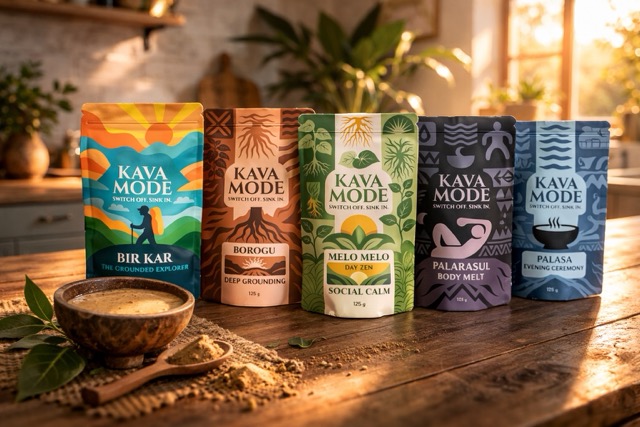
Premium Noble Kava
Discover certified quality and purity with our official partner.
Visit Kava-mode.comBrief & Concise
Clinical trials and systematic reviews report anxiety-reducing effects for certain standardized kava extracts, with results varying by study and preparation. GABA-A modulation and other mechanisms are being investigated. This does not prove absolute equivalence to benzodiazepines or guarantee freedom from drowsiness, cognitive effects or dependence. GABA is the main inhibitory neurotransmitter in the central nervous system. Experimental studies show that individual kavalactones, especially kavain, can modulate GABA-A receptors. This helps explain calming effects, but does not prove a guaranteed absence of drowsiness, cognitive impairment, tolerance or dependence.
Many consumers describe a gentle sense of wellbeing, social openness and calm contentment. Clinical trials of certain kava extracts support anxiolytic effects; a direct mood-elevating action of individual kavalactones through dopamine or serotonin has not been established in humans. Intensity and profile vary with product, dose and person.
Neurobiological Mechanisms
The effects of Kava are based on a complex interplay of various mechanisms in the brain:
- GABA Receptor Modulation:
GABA is the main inhibitory neurotransmitter in the central nervous system. Experimental studies show that individual kavalactones, especially kavain, can modulate GABA-A receptors. This helps explain calming effects, but does not prove a guaranteed absence of drowsiness, cognitive impairment, tolerance or dependence. - Sodium & Calcium Channel Blockade:
Many consumers describe physical and muscular relaxation. Preclinical work on sodium and calcium channels provides plausible mechanisms. Strength varies with product, dose and person, and larger amounts can cause drowsiness or impaired coordination. - MAO-B Inhibition:
Many consumers describe a gentle sense of wellbeing, social openness and calm contentment. Clinical trials of certain kava extracts support anxiolytic effects; a direct mood-elevating action of individual kavalactones through dopamine or serotonin has not been established in humans. Intensity and profile vary with product, dose and person. - Norepinephrine Reuptake Inhibition:
Many consumers describe low to moderate amounts as calming while retaining mental clarity; body-heavy profiles, higher amounts or individual sensitivity can nevertheless cause drowsiness and impair attention or reaction time. In Lehrl (2004), no cognitive impairment was observed for the tested LI 150 extract and study period; this is not a guarantee for every product, dose or person. - MAO-A Inhibition by Flavokawain A (New: 2026):
Pawa et al. (2026) found selective MAO-A inhibition by flavokawain A in in-vitro enzyme assays (IC50 0.077 µM); an artificial-membrane assay supported possible blood-brain-barrier passage, alongside in-silico modelling. The study tested neither humans nor antidepressant treatment with kava. - CB2 Receptor Agonism by Desmethoxyyangonin (New: 2026):
Mening'oo et al. (2026) studied DMY in ovariectomized mice, cell models and computer simulations. The data support a CB2-dependent bone effect in those preclinical models, not treatment of osteoporosis in humans or an effect of a kava beverage. - NF-κB and MAPK Signaling Pathway Regulation (Review 2026):
Pampita et al. (2026) is a review of kavain. It summarizes mainly mechanistic and preclinical findings plus limited clinical anxiety data; it calls for further human studies of efficacy and safety across the many other disease areas.
Psychological Effects
Positive
- ✅ Clinical trials and systematic reviews report anxiety-reducing effects for certain standardized kava extracts, with results varying by study and preparation. GABA-A modulation and other mechanisms are being investigated. This does not prove absolute equivalence to benzodiazepines or guarantee freedom from drowsiness, cognitive effects or dependence.
- ✅ Many consumers describe a gentle sense of wellbeing, social openness and calm contentment. Clinical trials of certain kava extracts support anxiolytic effects; a direct mood-elevating action of individual kavalactones through dopamine or serotonin has not been established in humans. Intensity and profile vary with product, dose and person.
- ✅ Many consumers describe low to moderate amounts as calming while retaining mental clarity; body-heavy profiles, higher amounts or individual sensitivity can nevertheless cause drowsiness and impair attention or reaction time. In Lehrl (2004), no cognitive impairment was observed for the tested LI 150 extract and study period; this is not a guarantee for every product, dose or person.
Neutral / Negative (in case of overdose)
- 😐 Sedation describes kava's **calming and sleep-supporting side**, which can become more prominent with body-centered Heavy profiles and higher doses. DHM, DHK, and Methysticin are often associated with this overall impression. Many people experience low to moderate amounts as mentally clear and relaxed. The degree of drowsiness depends on cultivar, batch, preparation, dose, and individual response.
- 😐 Many consumers describe physical and muscular relaxation. Preclinical work on sodium and calcium channels provides plausible mechanisms. Strength varies with product, dose and person, and larger amounts can cause drowsiness or impaired coordination.
Physical Effects
Traditional reports and preclinical studies describe mild pain-relieving and local-anesthetic effects. Numbness in the mouth demonstrates a local effect only; it is not direct proof of systemic pain relief and does not replace medical treatment.
Many consumers describe physical and muscular relaxation. Preclinical work on sodium and calcium channels provides plausible mechanisms. Strength varies with product, dose and person, and larger amounts can cause drowsiness or impaired coordination.
Heady, Balanced, Balanced-Heavy & Heavy
Four practical effect profiles are commonly described. A chemotype can provide clues but does not determine the experience by itself; cultivar, preparation, amount and individual response also matter.
Many consumers describe a gentle sense of wellbeing, social openness and calm contentment. Clinical trials of certain kava extracts support anxiolytic effects; a direct mood-elevating action of individual kavalactones through dopamine or serotonin has not been established in humans. Intensity and profile vary with product, dose and person.
Bir Kar (Vanuatu), Kelai (Vanuatu)
Many consumers describe a gentle sense of wellbeing, social openness and calm contentment. Clinical trials of certain kava extracts support anxiolytic effects; a direct mood-elevating action of individual kavalactones through dopamine or serotonin has not been established in humans. Intensity and profile vary with product, dose and person. Many consumers describe physical and muscular relaxation. Preclinical work on sodium and calcium channels provides plausible mechanisms. Strength varies with product, dose and person, and larger amounts can cause drowsiness or impaired coordination.
Melo Melo (Vanuatu)
Many consumers describe physical and muscular relaxation. Preclinical work on sodium and calcium channels provides plausible mechanisms. Strength varies with product, dose and person, and larger amounts can cause drowsiness or impaired coordination.
Borogu (Vanuatu)
Heavy is an experience-based term for body-centered, calming or sedating kava profiles. It cannot be assigned solely because DHK or DHM leads a chemotype; the complete profile, product, dose, preparation and person all matter. Such profiles are often chosen for the evening, but they are not a proven treatment for sleep disorders.
Palasa (Vanuatu), Palarasul (Vanuatu)
Duration & Course
- Onset: 10-20 minutes after ingestion (on an empty stomach).
- Peak: After about 30-60 minutes.
- Duration: The main effect lasts about 2-3 hours. A subtle relaxation ("afterglow") can last up to 6-8 hours.
- Sleep: Lehrl (2004, n=61, WS1490): Patients with stress-related sleep disorders showed significant improvements in sleep quality after 4 weeks of Kava intake. Wheatley (2001, n=24): Study on patients with anxiety and sleep disorders. Kava improved both anxiety symptoms and subjective sleep quality. Emser & Bartylla (1991): A small human EEG study in healthy participants reported more sleep-spindle activity and deep-sleep phases; REM sleep was unchanged. These are small, older or preparation-specific studies; larger modern replications are lacking.
Kava Kava Effects: clear relaxation instead of mere sedation
Search queries for "kava kava effects", "kava effects" or "piper methysticum effects" usually revolve around the same tension field: noticeable relaxation without complete loss of control. This is where Kava differs from many other sedative substances.
Calm instead of numb
Typically, there is an anxiolytic, muscle-relaxing, and socially opening effect with comparatively clear perception. Many users describe the state more as active relaxation than as dull sedation.
Strains shape the experience
Heady strains tend to be more sociable and mood-enhancing, while Heavy strains are more physically relaxing and suited for the evening. Therefore, the same gram amount can be experienced very differently depending on the strain.
The course remains mostly predictable
On an empty stomach, the effects usually set in relatively quickly, reach a peak, and then fade into a calmer after-phase. This course is typical but depends on the strain, grind, and session.
Dosage and context shape the effect
Between clear calmness and too heavy a session, it is often less about a different substance and more about a different dosage, preparation, or expectation. Therefore, effects must always be considered together with strain and setting.
In-depth pages on Kava effects
Effects on anxiety and tension
Many users seek Kava for inner peace and reduced stress. This subpage specifically consolidates this aspect of the effect.
Read about anxiety effectsMood and social openness
Heady Kava is often described as sociable, open, and mood-enhancing. This section focuses on this more everyday aspect of the profile.
Understand mood effectsSleep and evening effects
When fatigue and physical relaxation are more in focus, the sleep subpage helps categorize evening kavas and heavy sessions.
Categorize sleep effectsCompare strains and profiles
Why a session feels clear, social, or heavy depends heavily on strain and profile. The strain pages connect effects directly with the raw material.
Compare strainsFrequently Asked Questions about Kava Effects
Detailed Information
Click on the following cards to learn more about the individual areas of effect – with scientific backgrounds, recommended chemotypes, and practical application tips.
Anxiety Relief
How Kava alleviates anxiety and acts as a natural anxiolytic
Sleep & Relaxation
Sedative effects and application for sleep disorders
Muscle Relaxation
Physical relaxation and relief from tension
Mood & Social
Euphoric effects and social impact of Kava
Cognitive Effects
Focus, mental clarity, and the phenomenon of reverse tolerance
Based on studies by

With contributions from
This wiki is a curated resource that synthesizes research from peer-reviewed studies and expert researchers. It is not written by the researchers listed above, but rather based on their published work.
Scientific Sources
The information on this page is based on the following scientific studies and publications:
Kava extract for treating anxiety (Cochrane Review)
Pittler M.H., Ernst E. (2003) – Cochrane Database of Systematic Reviews
View studyPharmacokinetic and pharmacodynamic drug interactions with Kava (Piper methysticum Forst. f.)
Anke J., Ramzan I. (2004) – Journal of Ethnopharmacology
View studyKava-Kava Extract LI 150 Is as Effective as Opipramol and Buspirone in Generalised Anxiety Disorder
Lehrl S. (2004) – Phytomedicine
View studyContents
Premium Noble Kava
Discover certified quality and purity with our official partner.
Visit Kava-mode.com
Kava – Root of Calm
The comprehensive guide to effects, history & culture.