Table of Contents
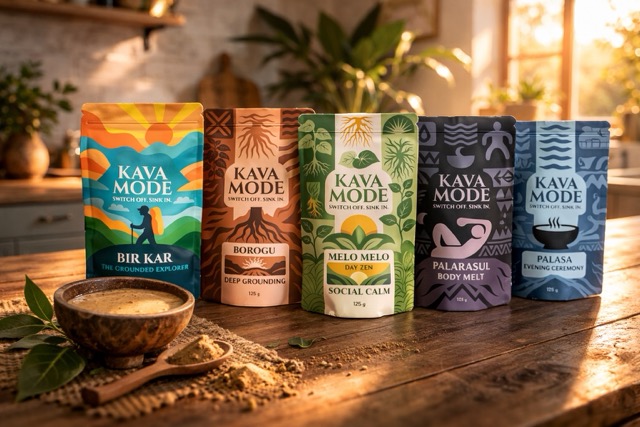
Premium Noble Kava
Discover certified quality and purity with our official partner.
Visit Kava-mode.comPiper methysticum, commonly known as Kava or Kava-Kava, is a tropical shrub from the pepper family (Piperaceae). The name Piper methysticum translates to "intoxicating pepper" (from the Greek methystikos = intoxicating).
Unlike many other psychoactive plants, Kava does not contain alkaloids as its main active compounds, but rather a unique class of substances known as Kavalactones. The plant has played a central role in Pacific Island cultures for thousands of years and is the result of millennia of human selection.
Scientific Classification
| Rank | Scientific Name |
|---|---|
| Kingdom | Plantae (Plants) |
| Division | Tracheophyta (Vascular Plants) |
| Order | Piperales (Pepper Order) |
| Family | Piperaceae (Pepper Family) |
| Genus | Piper (Pepper) |
| Species | Piper methysticum |
The closest related species is Piper wichmannii, which is considered the wild ancestor of today's cultivated Kava plant. While P. wichmannii (often called "Wild Kava") can reproduce sexually, cultivated P. methysticum is sterile and completely dependent on humans.
Piper methysticum: Species, Root and Quality Relevance
The botanical name Piper methysticum helps to understand why Kava is not just any herbal root. Species, propagation, cultivated varieties, and used plant parts explain many quality and effect differences.
A cultivated pepper species
Piper methysticum belongs to the family of Piperaceae and is therefore botanically related to other pepper species. However, in the Pacific, the plant has been culturally selected and specifically developed over a long time.
Sterile and vegetatively propagated
The Kava plant consumed today produces hardly any viable seeds and is mainly propagated through cuttings. This keeps variety profiles stable, but cultivation and availability heavily depend on human care.
Root and rhizome are crucial
For high-quality Kava products, root and rhizome components are particularly important. Leaves, unsuitable stem parts, or poorly separated plant materials degrade quality and safety profile.
Botany explains later effects
Piper methysticum is not just a name for labels. Vegetative propagation and cultivated varieties help to understand why origin, variety, and chemotype are so practically relevant in the Kava field.
In-depth pages on Piper methysticum
The plant at a glance
The plant section explains growth form, use, and the difference between Kava as a cultivated plant and general pepper plants.
Understand the plantMorphology from root to leaf
Anyone wanting to know which plant parts are important for quality and raw material will find a more detailed anatomical overview there.
View morphologyKavalactones as an active ingredient group
The botanical identity of Piper methysticum only becomes tangible together with its main constituents. This is about Kavalactones and profiles.
Read about KavalactonesPurchase relevance of botany
Botany becomes practical when evaluating products. The buying guide shows how plant part, variety, and transparency influence the purchasing decision.
To the buying guideFrequently Asked Questions about Piper methysticum
Morphological Overview
Kava is a perennial, evergreen shrub that typically reaches a height of 1.5 to 3 meters, but can grow up to 5 meters under optimal conditions.
Above-Ground Parts
- Leaves: Large, heart-shaped (cordate), 20-30 cm wide
- Stems: Knotty, bamboo-like, variety-specific coloring
- Flowers: Spike-shaped, sterile (no seeds)
Below-Ground Parts
- Stump (Corm): Thick, woody rootstock
- Lateral Roots (Waka): Finer roots, highest kavalactone content
- Weight: 5-25 kg in mature plants (3-5+ years)
Distribution & Habitat
Kava is native to the western Pacific. The origin is believed to be in northern Vanuatu, where the greatest genetic diversity exists. From there, the plant was spread across the entire Pacific by Polynesian seafarers ("Canoe Plants").
Today, Kava is mainly cultivated in the following regions:
- Vanuatu: The world's largest producer with over 80 different varieties.
- Fiji: Known for "Waka" (roots) and "Lewena" (basal stem).
- Tonga: Produces very mild, "creamy" Kavas (e.g., Pouni Ono).
- Samoa: Kava is called 'Ava here.
- Hawaii: Kava is called 'Awa here (e.g., Moi, Mahakea).
- Pohnpei & Micronesia: Known for consuming fresh Kava juice ("Sakau").
In-Depth Articles
Explore the following subpages for detailed information on specific aspects of Kava botany.
The Plant
Taxonomy, nomenclature, and the relationship between Piper methysticum and its wild ancestor Piper wichmannii.
Morphology
Detailed anatomy of the Kava plant with special focus on the economically important root system.
Cultivation & Ecology
Growth conditions, propagation methods, and the art of traditional Kava cultivation.
Based on studies by

CIRAD, French Agricultural Research Centre for International Development
View profile →With contributions from
This wiki is a curated resource that synthesizes research from peer-reviewed studies and expert researchers. It is not written by the researchers listed above, but rather based on their published work.
Scientific Sources
The information on this page is based on the following scientific studies and publications:
Kava: The Pacific Elixir - The Definitive Guide to Its Ethnobotany, History, and Chemistry
Vincent Lebot, Mark Merlin, Lamont Lindstrom (1997) – Yale University Press
View studyGenetic control of kavalactone chemotypes in Piper methysticum cultivars
Lebot V., Levesque J. (1996) – Phytochemistry
View studyMeasuring the Chemical and Cytotoxic Variability of Commercially Available Kava (Piper methysticum G. Forster)
Unknown (Unknown) – Unknown
View studyTable of Contents
Premium Noble Kava
Discover certified quality and purity with our official partner.
Visit Kava-mode.com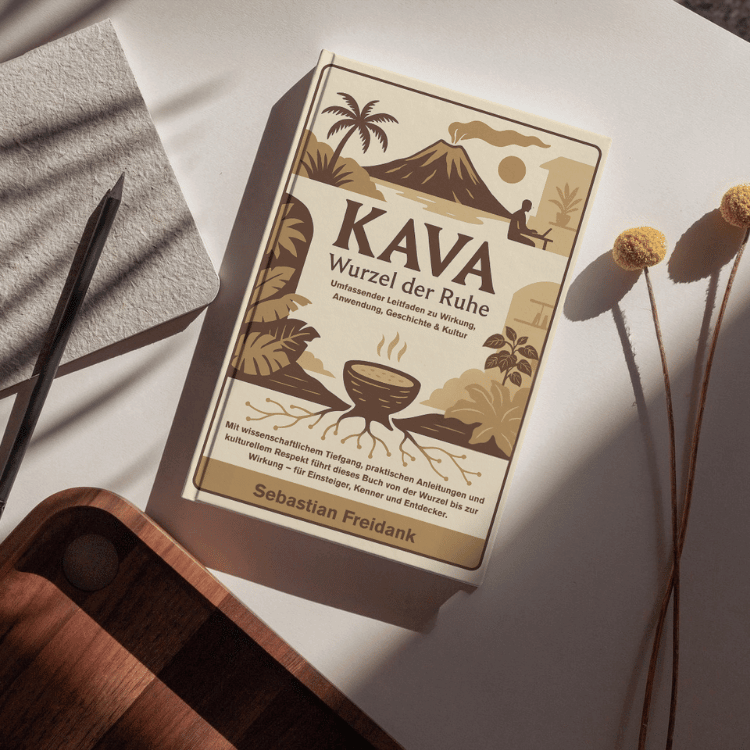
Kava – Root of Calm
The comprehensive guide to effects, history & culture.