
Contents
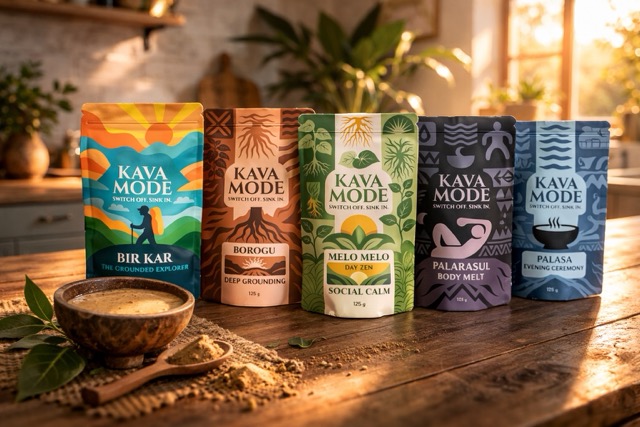
Premium Noble Kava
Discover certified quality and purity with our official partner.
Visit Kava-mode.comBrief & Concise
The anxiolytic effect (anxiolysis) is the best-documented and scientifically studied property of Kava. For millennia, the peoples of the Pacific have used the plant to find inner peace – and modern research confirms this traditional use.
GABA is the main inhibitory neurotransmitter in the central nervous system. Experimental studies show that individual kavalactones, especially kavain, can modulate GABA-A receptors. This helps explain calming effects, but does not prove a guaranteed absence of drowsiness, cognitive impairment, tolerance or dependence.
Mechanism of Action
The anxiolytic effect of Kava is based on a complex interplay of several neurobiological mechanisms. At the center is the modulation of the GABA system, but other neurotransmitter systems are also involved.
The GABA System
GABA (Gamma-Aminobutyric acid) is the most important inhibitory neurotransmitter in the brain. When GABA binds to its receptor, a chloride channel opens, negative ions flow into the nerve cell, and it becomes less excitable. The result: Calmness, relaxation, anxiety relief.
The Process of GABA Modulation
- 1. Kavain and other kavalactones reach the central nervous system after consumption
- 2. Experiments have shown positive modulation of several GABA-A receptor subtypes by kavain
- 3. The observed modulation occurs outside the classical benzodiazepine binding site and enhances the response to GABA
- 4. This can reduce neuronal excitability; kavalactones also affect sodium and calcium channels and monoamine systems
- 5. Overall experienced effect: calm, anxiety relief and muscle relaxation, often with preserved mental clarity
The experimentally observed GABA-A modulation supports kava's relaxing and anxiolytic effects. It is not equivalent to direct activation by every kavalactone. A typical physical dependence syndrome has not been established in the available kava evidence, but that clinical conclusion cannot be inferred from the binding site alone.
Additional Mechanisms
Sodium/Calcium Channel Blockade
Many consumers describe physical and muscular relaxation. Preclinical work on sodium and calcium channels provides plausible mechanisms. Strength varies with product, dose and person, and larger amounts can cause drowsiness or impaired coordination.
MAO-B Inhibition
Many consumers describe a gentle sense of wellbeing, social openness and calm contentment. Clinical trials of certain kava extracts support anxiolytic effects; a direct mood-elevating action of individual kavalactones through dopamine or serotonin has not been established in humans. Intensity and profile vary with product, dose and person.
Norepinephrine Reuptake Inhibition
Many consumers describe low to moderate amounts as calming while retaining mental clarity; body-heavy profiles, higher amounts or individual sensitivity can nevertheless cause drowsiness and impair attention or reaction time. In Lehrl (2004), no cognitive impairment was observed for the tested LI 150 extract and study period; this is not a guarantee for every product, dose or person.
CB1 Receptor Affinity
Many consumers describe a gentle sense of wellbeing, social openness and calm contentment. Clinical trials of certain kava extracts support anxiolytic effects; a direct mood-elevating action of individual kavalactones through dopamine or serotonin has not been established in humans. Intensity and profile vary with product, dose and person.
Scientific Studies
Clinical trials and systematic reviews report anxiety-reducing effects for certain standardized kava extracts, with results varying by study and preparation. GABA-A modulation and other mechanisms are being investigated. This does not prove absolute equivalence to benzodiazepines or guarantee freedom from drowsiness, cognitive effects or dependence.
Key Study Results
- Cochrane Review (Pittler & Ernst, 2003): Analysis of 11 randomized controlled trials with a total of 645 participants. Kava showed a significant superiority over placebo in the treatment of anxiety disorders.
- Sarris et al. (2013): Double-blind, placebo-controlled study with 75 participants with generalized anxiety disorder. Kava extract (120-240 mg Kavalactones/day) led to a significant reduction in anxiety symptoms.
"Clinical trials and systematic reviews report anxiety-reducing effects for certain standardized kava extracts, with results varying by study and preparation. GABA-A modulation and other mechanisms are being investigated. This does not prove absolute equivalence to benzodiazepines or guarantee freedom from drowsiness, cognitive effects or dependence."
Kava vs. Benzodiazepines
The comparison between Kava and benzodiazepines is particularly enlightening, as both act on the GABA system but with very different outcomes.
| Property | Kava | Benzodiazepines |
|---|---|---|
| Anxiolytic Effect | Clinical trials and systematic reviews report anxiety-reducing effects for certain standardized kava extracts, with results varying by study and preparation. GABA-A modulation and other mechanisms are being investigated. This does not prove absolute equivalence to benzodiazepines or guarantee freedom from drowsiness, cognitive effects or dependence. | Very strong |
| Cognitive Function | Many consumers describe low to moderate amounts as calming while retaining mental clarity; body-heavy profiles, higher amounts or individual sensitivity can nevertheless cause drowsiness and impair attention or reaction time. In Lehrl (2004), no cognitive impairment was observed for the tested LI 150 extract and study period; this is not a guarantee for every product, dose or person. | Impaired |
| Sedation | Sedation describes kava's **calming and sleep-supporting side**, which can become more prominent with body-centered Heavy profiles and higher doses. DHM, DHK, and Methysticin are often associated with this overall impression. Many people experience low to moderate amounts as mentally clear and relaxed. The degree of drowsiness depends on cultivar, batch, preparation, dose, and individual response. | Strong |
Advantages of Kava
- Clinical trials and systematic reviews report anxiety-reducing effects for certain standardized kava extracts, with results varying by study and preparation. GABA-A modulation and other mechanisms are being investigated. This does not prove absolute equivalence to benzodiazepines or guarantee freedom from drowsiness, cognitive effects or dependence.
- GABA is the main inhibitory neurotransmitter in the central nervous system. Experimental studies show that individual kavalactones, especially kavain, can modulate GABA-A receptors. This helps explain calming effects, but does not prove a guaranteed absence of drowsiness, cognitive impairment, tolerance or dependence.
- Some consumers report feeling little at first and experiencing kava more clearly after later sessions or with a lower amount. This is an observation and hypothesis, not a guaranteed three-to-seven-day sequence. Accumulation in body fat and receptor sensitization are not established mechanisms.
Recommended Chemotypes & Varieties
Several practical profiles are described for calming and anxiety-relieving experiences: heady cultivars often emphasize clarity and social openness, balanced cultivars an even calm, and balanced-heavy cultivars additional physical relaxation. Chemotypes provide clues but do not determine effects by themselves.
Borogu
Balanced-HeavyChemotyp: Literature reference: 423561 · Published analyses: 423516 / 423651
Calm, social and distinctly body-relaxing; preparation, amount and individual response can shift the experience further toward the heavy side.
Kelai
HeadyChemotyp: Literature reference: 423516 · Published analyses: 423156
Mentally light, clear, focused, communicative and socially open: a classic heady profile.
Melo Melo
BalancedChemotyp: Literature reference: 245361 · Modern analyzed/reported variants: 423156 / 243156
Balanced, smooth and centering, combining mental relaxation with gentle physical calm.
Pouni Ono (Tonga)
Chemotyp: 426315
Several practical profiles are described for calming and anxiety-relieving experiences: heady cultivars often emphasize clarity and social openness, balanced cultivars an even calm, and balanced-heavy cultivars additional physical relaxation. Chemotypes provide clues but do not determine effects by themselves.
Tudei Varieties (identified by DHM in position 1 or 2, e.g., chemotype 526431) are not suitable for anxiety treatment. They have strong sedative effects and can lead to fatigue the next day. Also, very "Heavy" varieties can be counterproductive when clarity is desired.
Practical Application
For the application in anxiety disorders, there are various strategies depending on whether it concerns acute situations or long-term support.
In Acute Anxiety
- Dosage: There is no universal kava dose. A practical guide for traditionally prepared medium-grind root powder is about 10-15 g for beginners and 15-25 g for experienced users; instant products should follow their own instructions. The often-cited 250 mg limit applies to certain standardized extracts, not to every water preparation. Too much, or risky combinations, can cause marked drowsiness, nausea, impaired coordination and other harms.
- Preparation: Traditionally kneaded in water
- Onset of Effect: 15-30 minutes
- Variety: Heady Kava (e.g., Kelai, Bir Kar)
- Tip: On an empty stomach for faster effect
For Daily Support
- Dosage: There is no universal kava dose. A practical guide for traditionally prepared medium-grind root powder is about 10-15 g for beginners and 15-25 g for experienced users; instant products should follow their own instructions. The often-cited 250 mg limit applies to certain standardized extracts, not to every water preparation. Too much, or risky combinations, can cause marked drowsiness, nausea, impaired coordination and other harms.
- Form: Traditional drink or capsules
- Timing: Evening or as needed
- Note: "Reverse Tolerance" – effect may increase over time
- Break: 1-2 days per week recommended
Reverse Tolerance
Some consumers report feeling little at first and experiencing kava more clearly after later sessions or with a lower amount. This is an observation and hypothesis, not a guaranteed three-to-seven-day sequence. Accumulation in body fat and receptor sensitization are not established mechanisms.
Continue in the chapter Effect:
Sleep & Relaxation
How Kava improves sleep and promotes deep relaxation
Based on studies by

With contributions from
This wiki is a curated resource that synthesizes research from peer-reviewed studies and expert researchers. It is not written by the researchers listed above, but rather based on their published work.
Scientific Sources
The information on this page is based on the following scientific studies and publications:
Kava extract for treating anxiety (Cochrane Review)
Pittler M.H., Ernst E. (2003) – Cochrane Database of Systematic Reviews
View studyKava in the treatment of generalized anxiety disorder: a double-blind, randomized, placebo-controlled study
Sarris J., Stough C., Bousman C.A., Wahid Z.T., Murray G., Teschke R., Savage K.M., Stough C., Byrne G.J., Scholey A. (2013) – Journal of Affective Disorders
View studyKava-Kava Extract LI 150 Is as Effective as Opipramol and Buspirone in Generalised Anxiety Disorder
Lehrl S. (2004) – Phytomedicine
View studyTherapeutic Potential of Kava in the Treatment of Anxiety Disorders
Singh Y.N., Singh N.N. (2002) – CNS Drugs
View studyContents
Premium Noble Kava
Discover certified quality and purity with our official partner.
Visit Kava-mode.com
Kava – Root of Calm
The comprehensive guide to effects, history & culture.