
Table of Contents
Premium Noble Kava
Discover certified quality and purity with our official partner.
Visit Kava-mode.comBrief & Concise
Despite colonial interventions, religious prohibitions, and global changes, Kava has not only survived – it is experiencing a powerful revival. In many Pacific societies, Kava today is more than ever an expression of cultural self-determination, identity, and resilience.
This renaissance is not limited to the Pacific. Kava has made the leap into the Western world – not as an exotic curiosity, but as a serious alternative to alcohol and synthetic sedatives. From Kava bars in Florida to online communities in Europe, a global Kava culture is emerging that combines traditional knowledge with modern wellness awareness.
Cultural Renaissance
After decades of marginalization by colonial powers and missionaries, Kava has been experiencing a remarkable revival since the 1980s. This renaissance is closely linked to independence movements and the growing pride in indigenous identity.
Driving Forces of the Renaissance
With independence (Vanuatu 1980, Fiji 1970), indigenous cultures could be publicly practiced again.
Kava became a symbol of resistance against cultural assimilation.
Kava export became an important source of income for Pacific states.
Scientific studies confirmed traditional knowledge about Kava.
"Kava has not come back – it was never gone. We are just beginning to listen again."
This renaissance is not just nostalgic – it is active and forward-looking. Younger generations are forming Kava collectives, digitally documenting traditional knowledge, and using social media to spread Kava culture worldwide.
Kava in the Pacific Today
Vanuatu
Kava is a national symbol. Port Vila is famous for its numerous Nakamals, where people from all walks of life gather in the evenings.
The government actively promotes Kava export and has introduced strict quality standards to export only Noble Kava.
Fiji
The Yaqona ceremony is an integral part of state protocol. No official reception without Kava – from state visits to village meetings.
Fiji is one of the largest Kava exporters in the world and has developed a thriving local Kava industry.
Tonga
The 'Ava ceremony remains central to political and social occasions. Strict etiquette is preserved and passed on to younger generations.
Tongan diaspora communities in New Zealand, Australia, and the USA actively maintain the Kava tradition.
Hawaii
After a decline during colonial times, 'Awa is experiencing a cultural revival. Hawaiian cultural groups are re-cultivating local varieties.
The University of Hawaii is actively researching Hawaiian 'Awa cultivars and their medicinal potential.
In all these regions, Kava today is more than a beverage – it is a cultural statement. Young people who may have once preferred alcohol are discovering Kava as a connection to their roots and as a healthier alternative.
Kava in the West
Western Kava culture has rapidly developed, especially since the 2010s. What began as a niche product for ethnobotany enthusiasts is now a growing movement with its own bars, communities, and media.
Kava Bars in the USA
Cities like Fort Lauderdale, St. Petersburg, Austin, and New York have developed vibrant Kava scenes. The bars position themselves as an alcohol-free alternative – a "Safe Space" for social interaction without loss of control.
Europe
In Europe, Kava culture is still in its infancy but is steadily growing. Germany, the UK, and the Netherlands have active online communities.
After the ban of 2002 and the rehabilitation in 2015 (Germany), Kava is slowly returning to the European market.
Online Communities
Reddit (r/kava), Facebook groups, and specialized forums have created a global Kava community that shares knowledge and helps newcomers.
These communities play an important role in quality control – poor products are quickly identified and warned against.
Kava & the Wellness Movement
Kava fits perfectly into the zeitgeist of the wellness movement. In a world searching for natural alternatives to synthetic medications and alcohol, Kava offers a unique combination of relaxation, clarity, and social connection.
Why Kava Fits the Wellness Movement
No synthetic additives, traditional use for thousands of years.
There is no blanket guarantee of being hangover-free or well tolerated
Scientifically proven anxiolytic effect.
Promotes genuine conversations instead of superficial interaction.
Clinical trials and systematic reviews report anxiety-reducing effects for certain standardized kava extracts, with results varying by study and preparation. GABA-A modulation and other mechanisms are being investigated. This does not prove absolute equivalence to benzodiazepines or guarantee freedom from drowsiness, cognitive effects or dependence.
Connection to a vibrant tradition, not just a product.
Especially the "Sober Curious" movement – people questioning or giving up their alcohol consumption – has discovered Kava as an ideal alternative. Kava offers the social function of alcohol (relaxation in company) without the negative consequences.
Kava also resonates in the realm of meditation and mindfulness. Its calming but not sedating effect supports meditative practices and helps focus the mind without clouding it.
Global Export
The global Kava market is steadily growing. What was once a local product is now an international export good that brings important income to Pacific communities.
| Country | Export Volume | Main Varieties | Special Features |
|---|---|---|---|
| 🇻🇺 Vanuatu | ~3,000 tons/year | Borogu, Melo Melo, Kelai | Strict Noble-Only Policy |
| 🇫🇯 Fiji | ~2,500 tons/year | Waka, Lawena | Largest exporter to the USA |
| 🇹🇴 Tonga | ~500 tons/year | Pouni Ono, Leka | Premium quality |
| 🇼🇸 Samoa | ~200 tons/year | 'Ava Lea, 'Ava Sa'a | Focus on quality |
Fair Trade & Ethical Consumption
With the growing market, awareness of ethical consumption is also increasing. More and more consumers are asking about:
● Origin: Where does the Kava come from? What variety is it?
● Quality: Is it Noble Kava? How was it tested?
● Fairness: Are the farmers paid fairly?
● Sustainability: Is it grown sustainably?
Challenges
The revival of Kava culture is not without challenges. Many Kava farmers struggle with structural problems that hinder sustainable cultivation.
For Producers
● Climate Change: Changing rainfall patterns and extreme weather threaten harvests.
● Infrastructure: Poor roads and lack of processing facilities.
● Price Pressure: Fluctuating world market prices and middlemen.
● Knowledge: Traditional knowledge is lost when youth migrate.
For Culture
● Commercialization: Risk of losing spiritual significance.
● Quality Issues: Tudei Kava and inferior products harm the reputation.
● Cultural Appropriation: Western use without understanding traditions.
● Regulation: Unclear legal situation in many countries.
It is important to not only consume Kava but to honor its cultural depth. This means informing oneself about origin and quality, paying fair prices, and respecting the traditions from which Kava originates.
Outlook
The future of Kava looks promising. With growing interest in natural alternatives to alcohol and synthetic medications, demand will continue to rise.
Trends and Developments
Ongoing studies on mechanisms of action, safety, and therapeutic potential will deepen understanding.
Instant Kava, capsules, and new preparation forms make Kava more accessible.
International certifications for Noble Kava will establish themselves.
Closer dialogue between Pacific producers and Western consumers.
More countries will create clear regulations.
"Kava is not a trend – it is a medicine, a culture, and a community. This combination makes Kava more than a trend – it makes it a movement."
The future of Kava culture lies in the hands of those who use it respectfully. Whether in the Nakamal of Port Vila, in a Kava bar in Florida, or at home – those who drink Kava become part of an ancient tradition that is constantly evolving while preserving its soul.
Read More
Related Topics
Based on studies by

With contributions from
This wiki is a curated resource that synthesizes research from peer-reviewed studies and expert researchers. It is not written by the researchers listed above, but rather based on their published work.
Scientific Sources
The information on this page is based on the following scientific studies and publications:
Kava: The Pacific Elixir - The Definitive Guide to Its Ethnobotany, History, and Chemistry
Vincent Lebot, Mark Merlin, Lamont Lindstrom (1997) – Yale University Press
View studyKava – Wurzel der Ruhe
Sebastian Freidank (2025) – Self-published
Table of Contents
Premium Noble Kava
Discover certified quality and purity with our official partner.
Visit Kava-mode.com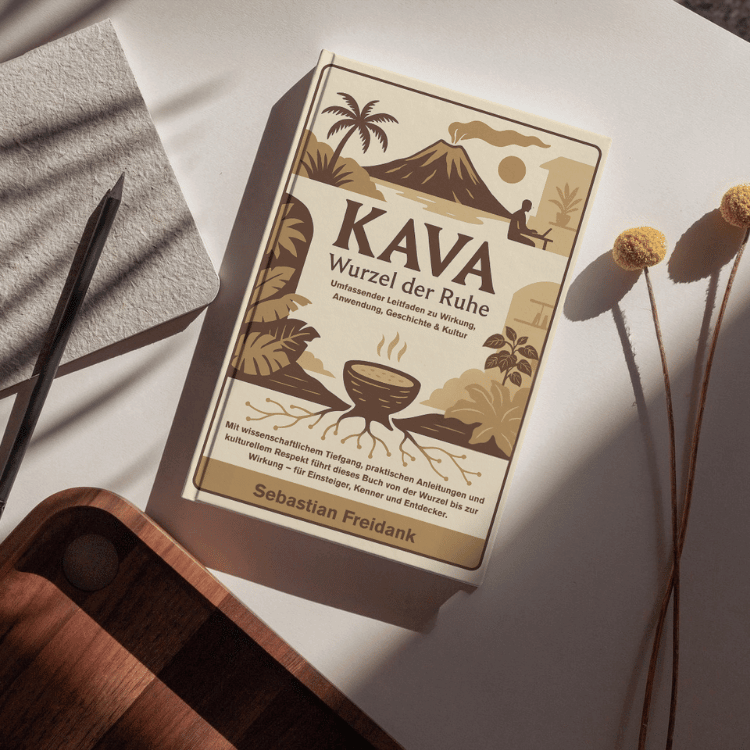
Kava – Root of Calm
The comprehensive guide to effects, history & culture.