Overview
This glossary explains the most important terms related to Kava. From chemical compounds to preparation methods and cultural traditions – here you will find all technical terms explained in an understandable way.
Chemistry & Ingredients
Kavalactones are a group of 18 lactones that shape kava's characteristic spectrum of effects. The six major kavalactones make up most of the fraction normally measured in analysis: Desmethoxyyangonin (DMY), Dihydrokavain (DHK), Yangonin (Y), Kavain (K), Dihydromethysticin (DHM), and Methysticin (M). Together they contribute effects ranging from clear anxiety-relieving calm and mood lift to muscle relaxation and sedation.
The chemotype is a 6-digit code that ranks the six major kavalactones by relative concentration. Each kavalactone has a number: 1=DMY, 2=DHK, 3=Y, 4=K, 5=DHM, 6=M. A chemotype such as "426315" means Kavain (4) ranks first, followed by DHK (2). The ranking helps describe a profile, but it contains no percentages and does not by itself determine the experienced effects or classify a sample as Heady, Heavy, Noble, or Tudei.
Kavain (number 4 in the chemotype system) is the best-researched kavalactone and is especially associated with clear, anxiolytic relaxation, a calmer mood, and mental clarity. Experimental work has observed modulation of several GABA-A receptors outside the classical benzodiazepine binding site. A leading Kavain position often fits a Heady impression but does not by itself prove cultivar quality or effect class.
Dihydrokavain (DHK, number 2 in the chemotype system) is especially associated with physical and muscular relaxation. Experimental work on voltage-gated sodium and calcium channels provides plausible mechanisms. A high relative DHK level can contribute to a calmer, more body-centered profile, but a leading 2 does not automatically make a cultivar Heavy.
Dihydromethysticin (DHM, number 5 in the chemotype system) is associated with deep physical calm, marked sedation, and an often longer-perceived profile. An early 5 can indicate a heavy or Tudei-like profile but does not prove Tudei by itself. Robust comparative human data for a fixed half-life or an automatically two-day effect are lacking; cultivar, plant parts, batch, dose, and the complete profile all matter.
Yangonin (Y, number 3 in the chemotype system) shows in-vitro affinity for CB1 cannabinoid receptors. This finding fits the often described mood-lifting and mildly euphoric side of some kava profiles, but it does not mean Yangonin acts like THC or kava like cannabis. Additional inflammatory and neurobiological properties are being investigated experimentally.
Desmethoxyyangonin (DMY, number 1 in the chemotype system) is associated with mood lift, focus, motivation, and social openness. Monoaminergic and MAO-B-related mechanisms are being investigated experimentally. A simplified explanation as a direct increase in dopamine levels is reductive, and DMY alone determines neither a Heady profile nor an antidepressant effect.
Methysticin (M, number 6 in the chemotype system) is associated with physical calm, a heavier evening profile, and sleep-supporting properties. Preclinical work also investigates anticonvulsant and neuroprotective mechanisms. Its specific effect and duration arise together with the other kavalactones, the dose, and the individual's response.
Piper methysticum is the scientific (Latin) name for the Kava plant. The name literally means "intoxicating pepper" (from Greek "methystikos" = intoxicating). The plant belongs to the family of pepper plants (Piperaceae) and is closely related to black pepper. Kava is a sterile cultivated plant that can only be propagated vegetatively – a sign of its millennia-old domestication by humans.
Piper wichmannii is the seed-producing wild form and an ancestor of cultivated kava. Both forms are decaploid (2n = 130). Primary genetic studies support neither a diploid wild form nor a demonstrated origin of decaploidy through repeated hybridization. Piper wichmannii is not among the Noble cultivars permitted for the kava beverage by Codex CXS 336R-2020.
Flavokawains A, B and C are kava chalcones. Their concentrations vary with genotype, plant part and processing. Biological and cytotoxic effects have mainly been studied preclinically; the six-digit kavalactone chemotype does not measure flavokawains.
Extraction refers to the process of dissolving Kavalactones from the plant material. In traditional preparation, this is done by kneading in water – Kavalactones are fat-soluble and are extracted through mechanical force and emulsification. Industrial extracts often use solvents like ethanol or acetone. Aqueous extracts are considered safer as they contain fewer undesirable compounds.
Effects & Efficacy
GABA is the main inhibitory neurotransmitter in the central nervous system. Experimental studies show that individual kavalactones, especially kavain, can modulate GABA-A receptors. This helps explain calming effects, but does not prove a guaranteed absence of drowsiness, cognitive impairment, tolerance or dependence.
Some consumers report feeling little at first and experiencing kava more clearly after later sessions or with a lower amount. This is an observation and hypothesis, not a guaranteed three-to-seven-day sequence. Accumulation in body fat and receptor sensitization are not established mechanisms.
Related Terms:Kavalactones, Dosage Clinical trials and systematic reviews report anxiety-reducing effects for certain standardized kava extracts, with results varying by study and preparation. GABA-A modulation and other mechanisms are being investigated. This does not prove absolute equivalence to benzodiazepines or guarantee freedom from drowsiness, cognitive effects or dependence.
“Krunk” is community slang for a clearly perceived kava effect involving relaxation and well-being. Some people experience mental clarity, but higher amounts or body-heavy profiles can cause drowsiness, slower reactions or coordination problems.
Many consumers describe physical and muscular relaxation. Preclinical work on sodium and calcium channels provides plausible mechanisms. Strength varies with product, dose and person, and larger amounts can cause drowsiness or impaired coordination.
Many consumers describe a gentle sense of wellbeing, social openness and calm contentment. Clinical trials of certain kava extracts support anxiolytic effects; a direct mood-elevating action of individual kavalactones through dopamine or serotonin has not been established in humans. Intensity and profile vary with product, dose and person.
Sedation describes kava's calming and sleep-supporting side, which can become more prominent with body-centered Heavy profiles and higher doses. DHM, DHK, and Methysticin are often associated with this overall impression. Many people experience low to moderate amounts as mentally clear and relaxed. The degree of drowsiness depends on cultivar, batch, preparation, dose, and individual response.
Cell and animal studies suggest that some kavalactones may have neuroprotective properties. This is preclinical evidence and does not prove that kava prevents or treats neurodegenerative disease, nor that it always preserves cognitive performance.
Related Terms:Kavain, Kavalactones Traditional reports and preclinical studies describe mild pain-relieving and local-anesthetic effects. Numbness in the mouth demonstrates a local effect only; it is not direct proof of systemic pain relief and does not replace medical treatment.
Kava dermopathy is a dry, scaly skin change described mainly with high, long-term consumption and usually improves after reducing or stopping use. Course and mechanism are not identical in every person, and a skin change does not replace assessment for other medical causes.
Varieties & Strains
Noble Kava refers to cultivated, traditionally valued kava cultivars selected for a well-tolerated, clearer, and reliably fading profile. Many documented Noble chemotypes begin with 4 or 2, but that ranking is only a clue. Robust classification also requires cultivar identity, plant parts, origin, processing, and analytical quality data. Vanuatu restricts legal export to approved Noble cultivars.
Tudei (from "two day") refers to kava cultivars not classified as Noble that are traditionally described as heavier, longer-lasting, and more often associated with nausea, headaches, or next-day after-effects. A higher relative level of Dihydromethysticin (DHM) or Flavokavain B can inform quality assessment, but a leading 5 does not prove Tudei by itself. Export of Tudei kava is prohibited in Vanuatu; documented cultivar identity and quality data are decisive.
Many consumers describe a gentle sense of wellbeing, social openness and calm contentment. Clinical trials of certain kava extracts support anxiolytic effects; a direct mood-elevating action of individual kavalactones through dopamine or serotonin has not been established in humans. Intensity and profile vary with product, dose and person.
Heavy is an experience-based term for body-centered, calming or sedating kava profiles. It cannot be assigned solely because DHK or DHM leads a chemotype; the complete profile, product, dose, preparation and person all matter. Such profiles are often chosen for the evening, but they are not a proven treatment for sleep disorders.
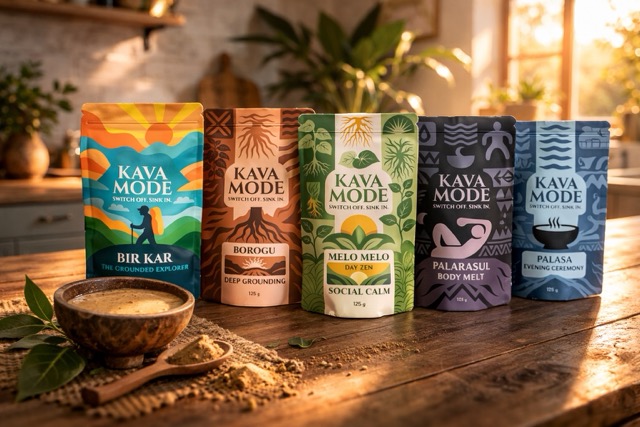
"Balanced" describes kava cultivars with an even mix of mental and physical relaxation. Melo Melo is a typical example. Borogu is classified as Balanced-Heavy, Bir Kar and Kelai as Heady, and Palasa and Palarasul as Heavy.
A cultivar is a plant variety created through breeding. There are over 100 different cultivars of Kava, which vary in chemotype, effects, flavor, and growth form. Since Kava is sterile and can only be propagated vegetatively, cultivars are genetic clones of the mother plant. Well-known cultivars include Borogu, Kelai, Melo Melo, Palasa, and many more. Each cultivar has its own "fingerprint" of Kavalactones.
In the Fiji Kava Quality Manual, waka means the roots, usually lateral roots, kept separate from the peeled rhizome called lewena. Roots often contain more kavalactones on average, but waka is not automatically higher quality, stronger, milder in taste or predictably different in effect. Cultivar, plant age, processing, storage and analysis also matter.
In the Fiji Kava Quality Manual, lewena means the peeled stump or rhizome prepared as chips and kept separate from waka roots. It may contain fewer kavalactones on average, but it is not automatically mild, low quality or reserved for daily use. Cultivar, plant age, processing, mixture and analysis determine the final product.
"Green Kava" or "Fresh Kava" refers to freshly harvested Kava roots that have not been dried. In the Pacific origin countries, Kava is traditionally prepared fresh – the roots are peeled, chopped, and immediately kneaded. Fresh Kava has a different taste and effect than dried: often milder, "greener" in flavor, and with a faster onset of effects. Instant Kava is made from dehydrated Green Kava juice.
'Awa is the Hawaiian name for kava. Hawaii has its own cultivars and a long history of ceremonial, medicinal and spiritual use. Potency and effect profile vary by cultivar, product, dose and person and cannot be inferred from the name 'Awa alone.
Preparation
Medium grind is the usual grind for traditional kneading and blender preparation. The plant material is worked with water and then filtered through a suitable straining cloth. Grind size alone does not guarantee potency; raw material, kavalactone content, amount and preparation also matter.
Micronized kava is finely ground and usually sieved root or rhizome material. It does not dissolve: insoluble plant particles remain suspended and are consumed with the drink.
Instant kava is a dried, previously water-prepared kava beverage. It can be mixed directly with water and requires no kneading or straining. This is not the same as micronized kava, whose fine plant particles remain in suspension and are consumed. Concentration and serving directions vary by product, so the product label matters more than a universal gram comparison.
In the traditional kneading method, medium-grind kava is kneaded and wrung in a suitable straining cloth for about 10–15 minutes in lukewarm water. A range of 40–60 °C is practical; boiling water is unnecessary. Mechanical handling distributes kavalactones and fine material in the liquid, which is then consumed fresh.
A second wash reuses plant material that has already been kneaded. Some active material may remain, but strength varies greatly with the first preparation, raw material, water and technique; there is no reliable universal figure of 30-50 percent. Reuse it promptly and hygienically, and consume the beverage fresh.
A strainer bag is a filter bag made of nylon or cotton used for kneading and filtering Kava. The ideal mesh size is 75-100 microns – fine enough to retain plant fibers but permeable enough for the Kavalactone emulsion. Strainer bags are reusable and should be rinsed and dried after each use. They are an essential tool for traditional preparation.
"Shell" is the common term for a serving of Kava drink, typically 100-150ml. The term originates from the traditional coconut shell (Bilo) from which Kava is drunk. In Kava bars, one orders "Shells" – a session often consists of 3-6 Shells over several hours. The dosage per Shell varies depending on the strength of the Grog and personal preference. "One more shell" is a common exclamation in the Kava community.
The AluBall is a modern Kava preparation device that simplifies the traditional kneading method. It consists of a shaker bottle with a special strainer ball. Medium Grind powder is placed in the ball, water is added, and shaken for 2-3 minutes. The extraction is faster than traditional kneading but may be less efficient. The AluBall is popular for on-the-go and for beginners who prefer an easy preparation.
Culture & Tradition
"Grog" is the colloquial term for the finished Kava drink, especially in Vanuatu and Fiji. The name originates from the colonial era and was adopted by the British Navy. Traditional Kava Grog has a milky-brown color (like coffee with milk) and an earthy, slightly peppery taste. In Kava bars, Grog is often served in coconut shells (Bilos) and drunk in one go.
A Bilo is a half coconut shell traditionally used for serving and drinking Kava. In Fiji and other Pacific cultures, drinking from the Bilo is part of the ceremonial ritual. Before drinking, one claps once, says "Bula!" (Fiji) or "Mālō!" (Tonga), drinks the contents in one go, and then claps three times. Modern Kava enthusiasts use Bilos for an authentic experience.
A Nakamal is a traditional Kava bar in Vanuatu, where locals and tourists gather to drink Kava. Originally, the term referred to the men's meeting place in the village. Modern Nakamals are often simple huts or open areas with benches. Kava is prepared fresh and served in bowls. There are strict social rules: one speaks quietly, behaves respectfully, and drinks at dusk. Nakamals are important social gathering places.
A Tanoa is a large, flat wooden bowl in which Kava is traditionally prepared and served. It is typical for Fiji, Samoa, and Tonga and is carved from a single piece of wood, often with carved legs. The Tanoa is the center of the Kava ceremony – the Grog is mixed in it and distributed to participants with a Bilo. High-quality Tanoas are artworks and are passed down as family heirlooms.
"Bula!" is the traditional Fijian greeting that is called out before drinking a Shell of Kava. The word means "life" and expresses good wishes. The ritual: clap once, shout "Bula!", empty the Shell in one go, and clap three times. In other Pacific cultures, there are similar calls: "Mālō!" in Tonga, "Taki!" in Vanuatu. These rituals create community and respect and are an important part of Kava culture.
Safety
Flavokawain B (FKB) is a kava chalcone studied for cytotoxic and other biological effects in cell and animal models. Its concentration varies with genotype, plant part and processing. FKB alone has not been shown to explain the historical human liver cases, and the six-digit kavalactone chemotype does not measure flavokawains.
In-vitro studies using human liver microsomes show that kava extracts and individual kavalactones can inhibit several CYP450 enzymes. Small human studies, however, found different effects depending on the preparation and consumption pattern, including effects on CYP1A2 or CYP2E1 but not uniform inhibition of every enzyme affected in the laboratory. Clinical relevance depends on the product, dose and medicine.
WHO/FAO assess traditionally water-prepared kava beverages as generally low risk, but not risk-free, with moderate consumption. Rare human liver cases are documented and cannot be attributed wholesale only to Tudei, aerial plant parts or one extraction method. Product quality, plant part, dose, comorbidity and co-medication all matter in risk assessment.
Kava can interact with medicines and other central nervous system depressants. Alcohol, benzodiazepines, sleep medicines and other sedatives should not be combined without professional review. Controlled clinical evidence is lacking for many blanket CYP, antidepressant, anticoagulant or Parkinson-drug claims, so regular medication warrants individual medical or pharmacy review.
There is no universal kava dose. A practical guide for traditionally prepared medium-grind root powder is about 10-15 g for beginners and 15-25 g for experienced users; instant products should follow their own instructions. The often-cited 250 mg limit applies to certain standardized extracts, not to every water preparation. Too much, or risky combinations, can cause marked drowsiness, nausea, impaired coordination and other harms.
Chemotype reference
| # | Kavalactone | Abbr. | Evidence |
|---|
| 1 | Desmethoxyyangonin | DMY | Evidence is mainly in vitro or preclinical; comparative human data are limited. |
| 2 | Dihydrokavain | DHK | Evidence is mainly in vitro or preclinical; comparative human data are limited. |
| 3 | Yangonin | Y | Evidence is mainly in vitro or preclinical; comparative human data are limited. |
| 4 | Kavain | K | Evidence is mainly in vitro or preclinical; comparative human data are limited. |
| 5 | Dihydromethysticin | DHM | Evidence is mainly in vitro or preclinical; comparative human data are limited. |
| 6 | Methysticin | M | Evidence is mainly in vitro or preclinical; comparative human data are limited. |